
Weird Plant Wednesday: Peculiar Parasites
Welcome to Weird Plant Wednesday, a series of field notes about some of the bizarre plants of Alberta's boreal wetlands – plants that AJMers are privileged to see during summer field work in northern Alberta!
Carnivorous plants cope with the scarcity of nutrients in peatlands by eating animals. Parasitic plants? They just steal.
It doesn't get much weirder than parasitic plants. The ghost pipe, Monotropa uniflora, could easily be mistaken for a mushroom. It's an almost translucent shade of white, with a bell-shaped flower like a ghost costume made from a sheet. Underground, its roots reach out to the threadlike network of mycorrhizal fungi. These fungi usually form a close symbiotic partnership with plants via their roots; the plants share sugars made by photosynthesis with the fungus, while the fungi contribute minerals extracted from the soil to the plant. Ghost pipe makes this relationship more one-sided, drawing on other plants’ sugars and the fungi’s nutrients without contributing anything in exchange. And because it completely skips photosynthesis, it has no chlorophyll, the pigment that makes plants green.
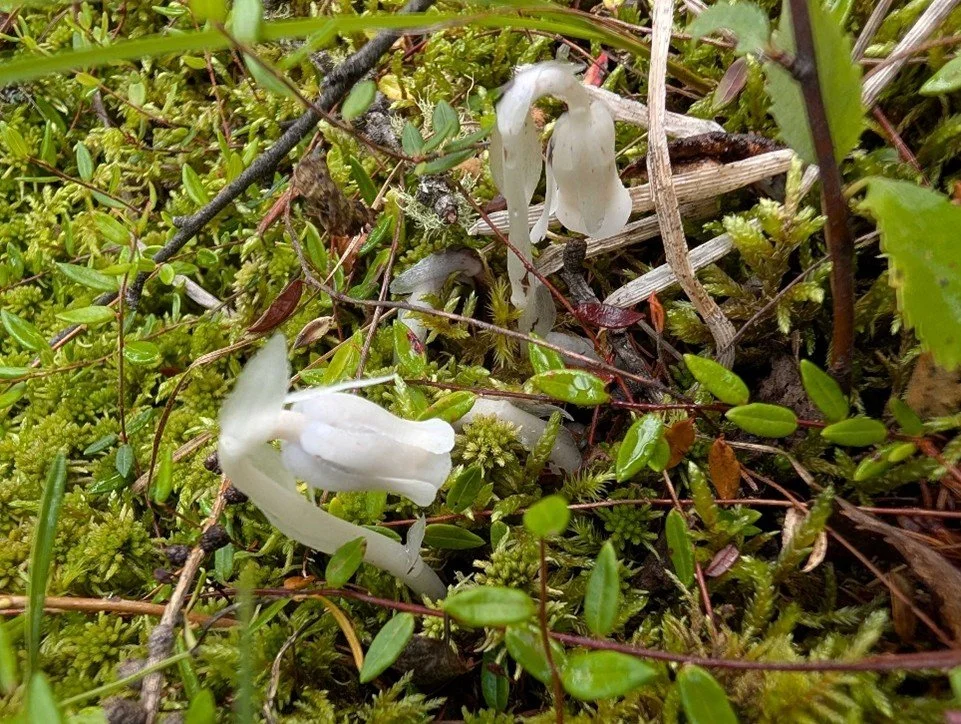
Ghost pipe (Monotropa uniflora) flowers. Alberta peatlands are also home to a parasitic orchid called early coralroot (Corallorhiza trifida). It’s part of a large genus of parasitic orchids and, with distribution across the New and Old World boreal forests, is the only species of the genus that occurs outside North America. Its small, greenish flowers bloom on slender stalks with tiny leaves early in the growing season.
While its green hue suggests that coralroot can photosynthesize, research shows that most of its nutrients come from the plants around it via mycorrhizal fungi (Cameron et al. 2009).
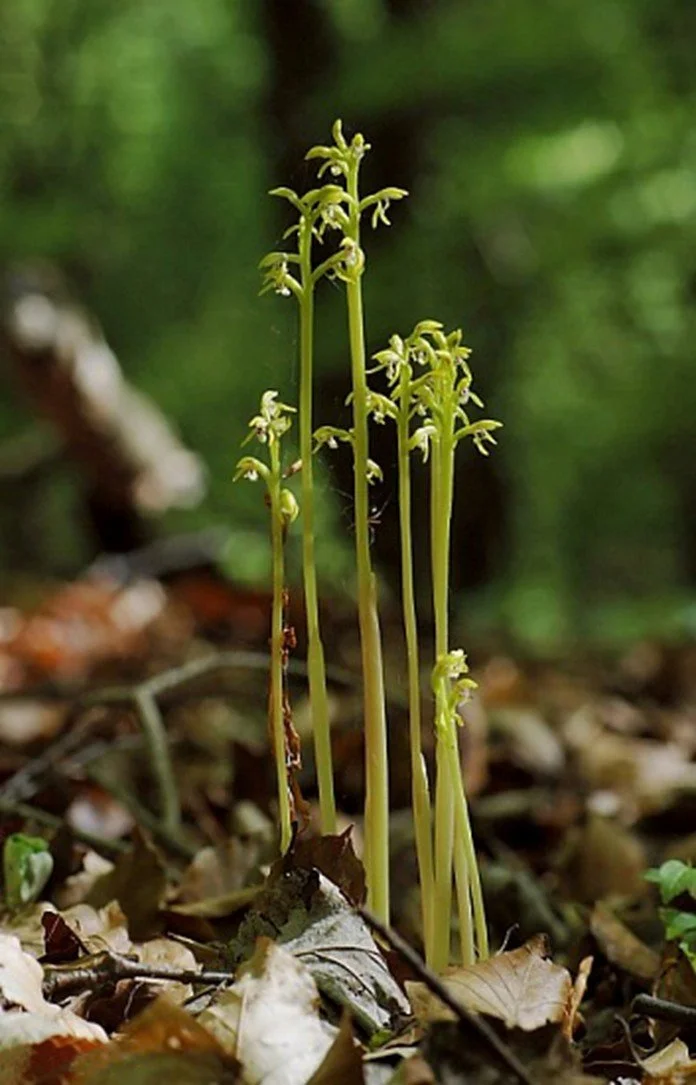
Early coralroot (Corralorhiza trifida) flowers. Photo by Wikipedia user Dcoetzee; used under Creative Commons Attribution-Share Alike 3.0 Unported license (https://creativecommons.org/licenses/by-sa/3.0/).This past summer, I learned that another boreal wetland plant, northern comandra (Geocaulon lividum), is partly parasitic.
Northern comandra, as shown in the photo below, is possibly the most nondescript plant ever: short with pale green leaves opposite each other on the stem, hardly distinguishable from the various other understory species at a glance. Unlike coralroot and ghost pipe, it photosynthesizes – hence the green leaves – but it also helps itself to nutrients from the plants around it, using a structure called a haustorium that grows from its roots into the other plant's tissues. Unlike coralroot and ghost pipe, northern comandra’s parasitic relationship appears not to involve mycorrhizal fungi. Northern comandra is actually related to mistletoes, which are parasites that grow on tree branches (apologies if this ruins any holiday traditions for you).
While parasitic plants seem like the seedy (pun unapologetically intended) underbelly of the botanical world, their feeding strategy makes sense in nutrient-poor boreal wetlands. And their often unplantlike appearance make them unusual little treasures to look for among the mossy muskeg.
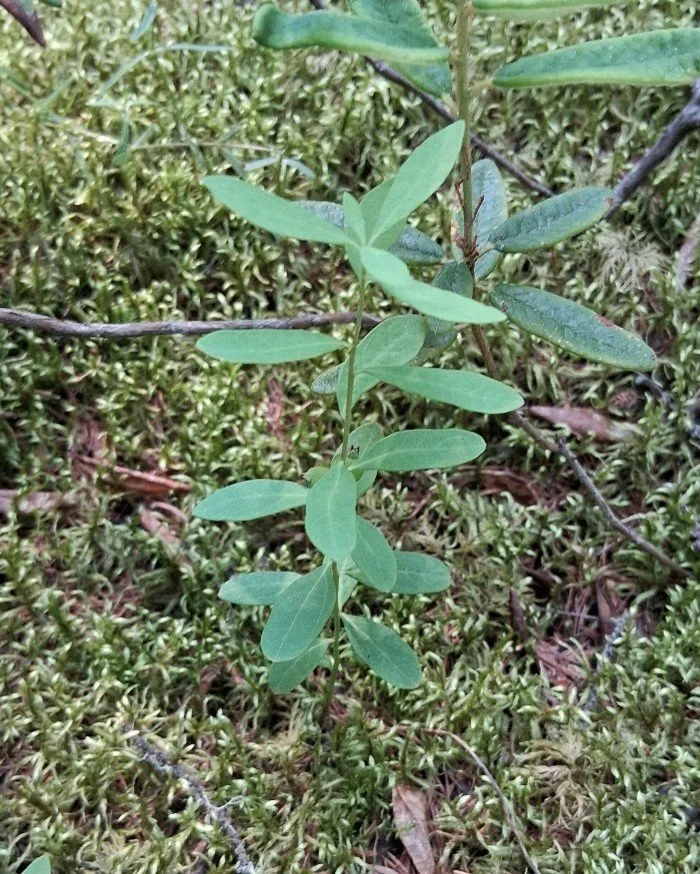
Northern comandra (Geocaulon lividum).Written By: Laura Southcott, MSc., PhD., PBiol., RPBio. - AJM Intermediate Biologist
References:
Cameron, Duncan D., Katja Preiss, Gerhard Gebauer, and David J. Read. 2009. "The chlorophyll‐containing orchid Corallorhiza trifida derives little carbon through photosynthesis." New Phytologist 183, no. 2: 358-364.