
Weird Plant Wednesday: Curious Carnivores
Welcome to Weird Plant Wednesday, a series of field notes about some of the bizarre plants of Alberta's boreal wetlands – plants that AJMers are privileged to see during summer field work in northern Alberta!
When you think of carnivorous plants, do you think of lush tropical rainforests? Or perhaps Little Shop of Horrors, with its failing neighbourhood florist where people keep breaking out into song? You probably don’t think of the cool, mosquito-filled wetlands of northern Canada. But in fact, Alberta is home to at least 12 species of carnivorous plants!
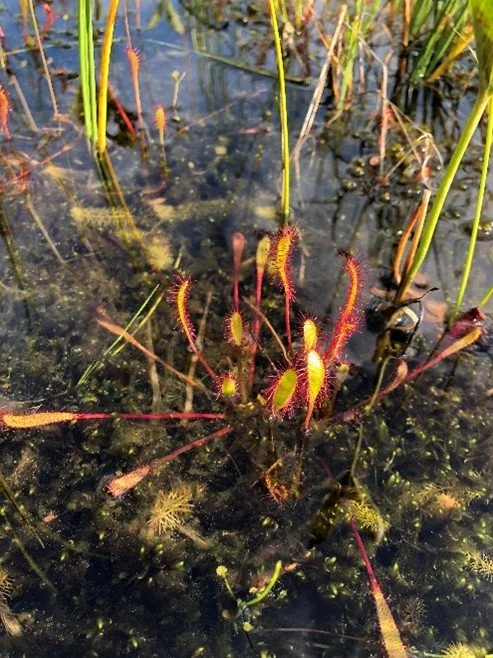
English sundew (Drosera anglica), plus Drosera rotundifolia and Utricularia vulgaris – can you spot them all?
Peatlands are where carnivorous plants thrive. Because peat is made up of dead plants that have stopped decaying, their nutrients aren't available for other plants to recycle (see last Wednesday’s Weird Plant post about Sphagnum). Plants that live in peatlands have lots of strategies to cope with these nutrient-poor conditions and obtain scarce nutrients, but carnivorous plants have one of the coolest. Unsurprisingly, that strategy is...being carnivorous!
These plants catch and digest insects and other invertebrates, something that boreal peatlands have in abundance (if you know, you know). The ability to catch and eat animals has evolved 12 times in flowering plants, and the ways these plants hunt are incredibly diverse.
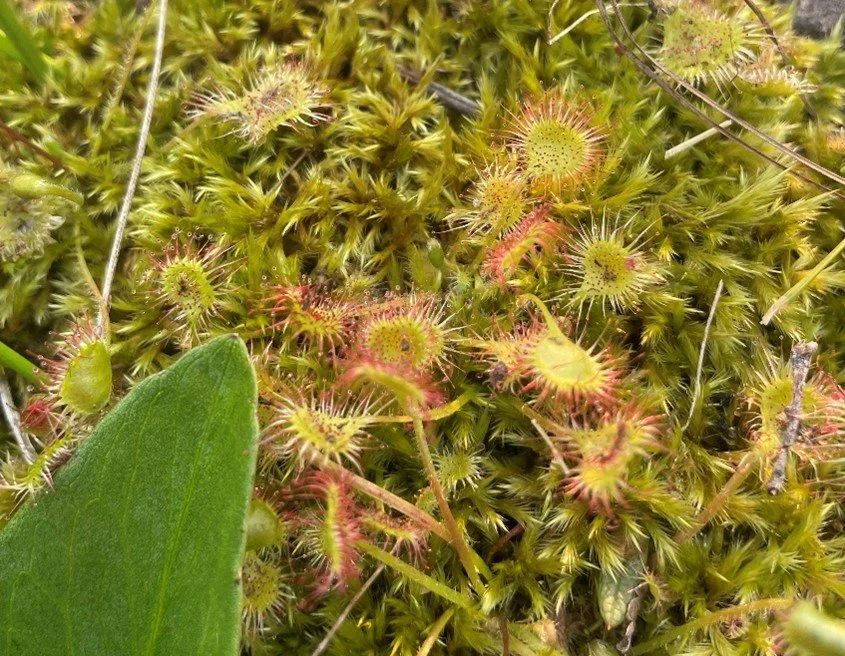
Round-leaved sundew (Drosera rotundifolia).
Sundews, like Drosera rotundifolia as shown above, win the prize for both prettiest name and most nightmarish method of catching prey. They have tentacles on their leaves tipped with droplets of sticky liquid that attract bugs with a sweet smell. The bugs get trapped in the sticky stuff, and as they struggle to escape, the leaves start to fold inward, coating the insects in more slime. Then the plant exudes digestive chemicals to break down the trapped prey. In my opinion, if Audrey II was a sundew instead of a glammed-up Venus flytrap, Little Shop of Horrors would've been a much scarier movie.
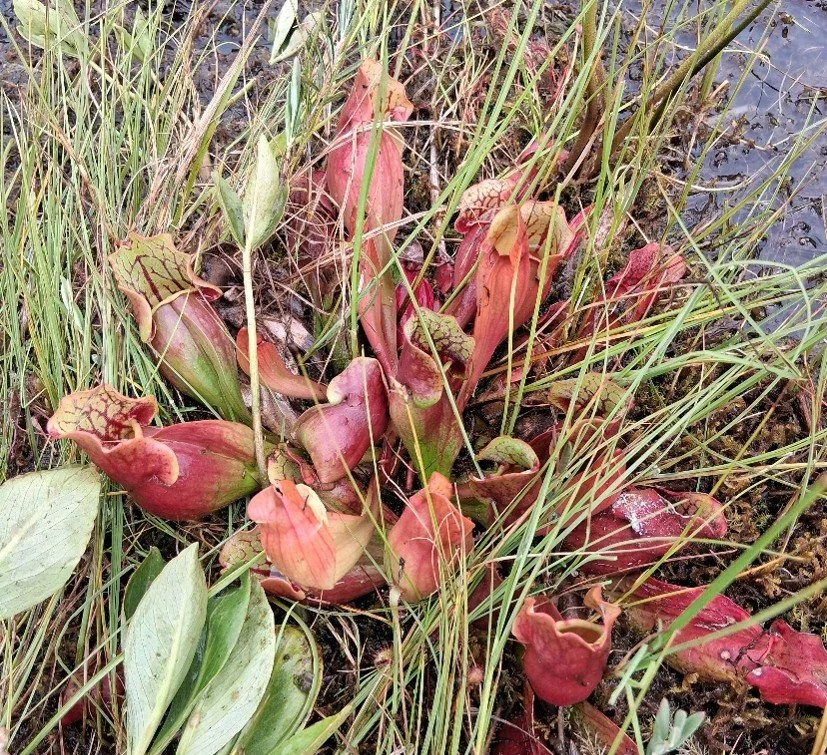
Purple pitcher plant (Sarracenia purpurea).
Pitcher plants grow their leaves into structures that look like, well, pitchers. The pitchers fill with rainwater, as well as digestive juices produced by the plant. Insects, attracted by the plant's scent, fall down the pitcher's slippery sides. The single species of pitcher plant in Alberta, Sarracenia purpurea, ranges in colour from burgundy to neon green.
Butterworts (Pinguicula spp.), like sundews, use sticky leaves to catch prey. But they look quite different (and are only distantly related). Their leaves are wide and succulent, and the sticky liquid covering them glistens, supposedly like butter (bright green butter, perhaps from an early draft of a Dr. Seuss book).
Bladderworts (Utricularia spp.) are widespread aquatic plants that look like limp, green bottlebrushes. Their name comes from tiny, hollow structures (like bladders) that are actually sophisticated traps for aquatic invertebrates – and sometimes vertebrates, as they have been known to capture fish fry and tadpoles! The plant pumps water out of the bladders to create a vacuum, and a "trap door" springs open when an unfortunate water flea or other prey bumps into a hairlike "trigger", sucking the prey inside.
One thing these plants have in common is that they all depend on insects for pollination. To avoid accidentally eating their pollinators, they grow flowers on very tall stems to keep them far away from the traps.
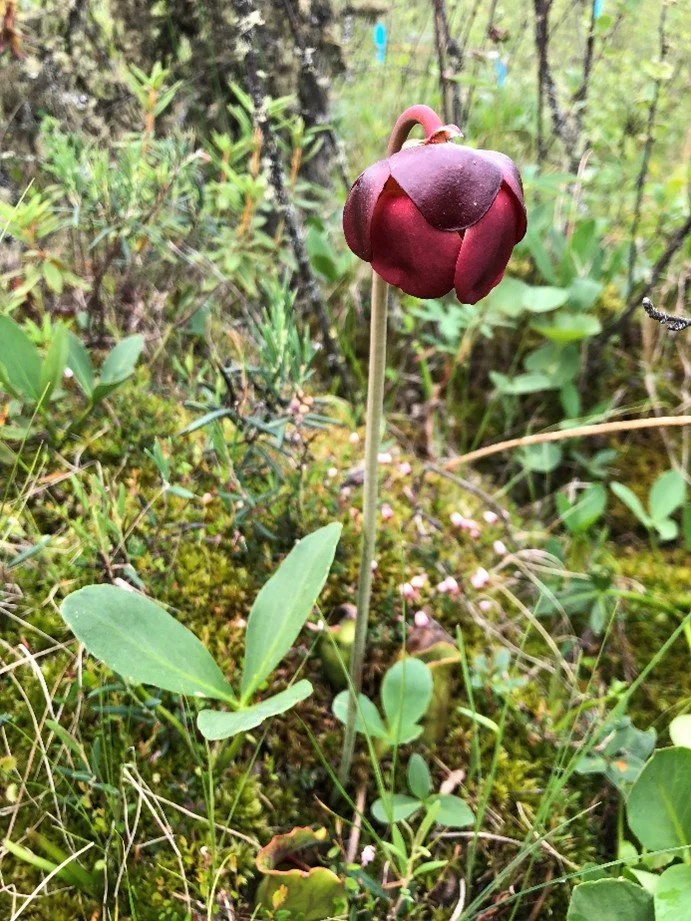
Flower of the pitcher plant Sarracenia purpurea.
But wait...there's one more carnivorous plant that defies the conventional wisdom that you shouldn't digest the fly that pollinates you! In 2021, researchers at the University of British Columbia discovered that the western false asphodel, Triantha occidentalis, is carnivorous (Qianshi et al. 2021). It has short, sticky hairs along its stems, just below its flowers, which trap and digest small flies. Its flowers are pollinated mainly by much larger butterflies and bees, which may be large enough to avoid getting stuck if they land on the sticky stem. The authors also note that other species of Triantha are likely carnivorous too, and we at AJM are excited to look for some Triantha glutinosa next field season to check their stems for trapped bugs.
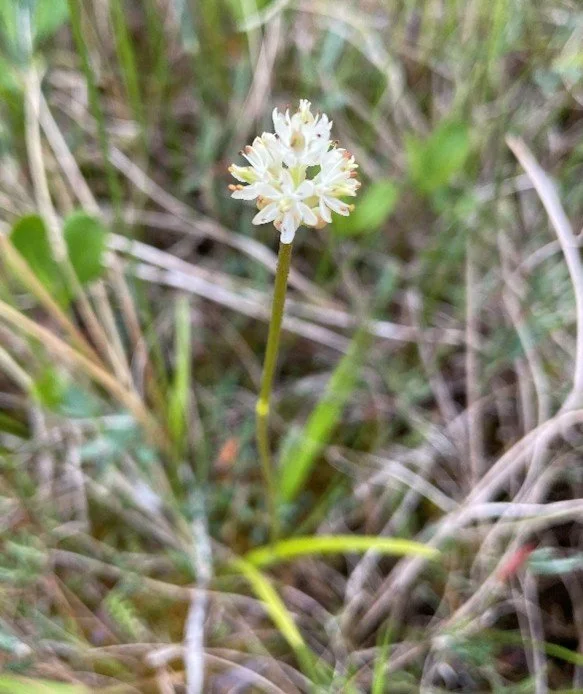
Flower of Triantha glutinosa, possibly a carnivorous plant.
Written By: Laura Southcott, MSc., PhD., PBiol., RPBio. - AJM Intermediate Biologist
References:
Lin, Qianshi, Cécile Ané, Thomas J. Givnish, and Sean W. Graham. 2021. "A new carnivorous plant lineage (Triantha) with a unique sticky-inflorescence trap." Proceedings of the National Academy of Sciences 118, no. 33: e2022724118.