
The Bison-Bird: Rethinking the Cowbird's Reputation
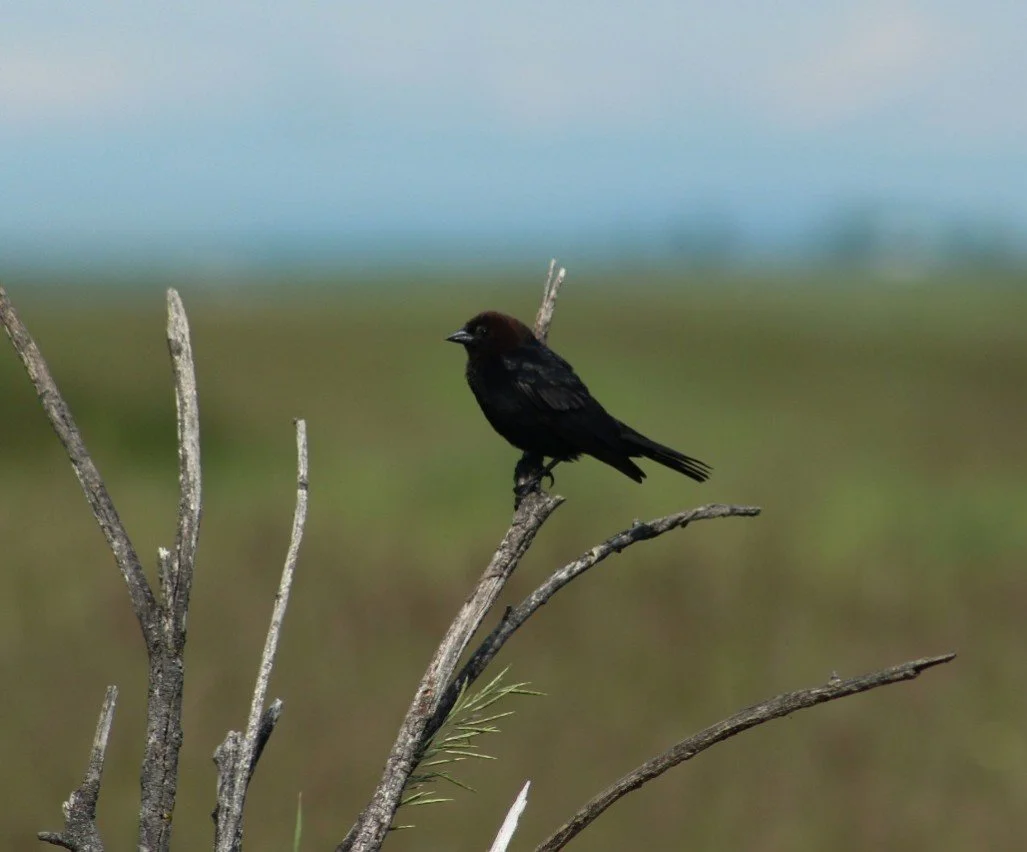
Brown-headed Cowbird (Molothrus ater)
She has been watching the sparrows for days, first quietly as the female gathered twigs, dry grass, and bison hair; then more openly, strategically entering the sparrows' territory, raising a flurry of chirps from the pair, louder and more frantic the closer she came to their nest. The intruder is a drab grey-brown bird, without the intricate streaks and stripes of the sparrows, matching the dust raised by the bison herd that grazes the prairie around them.
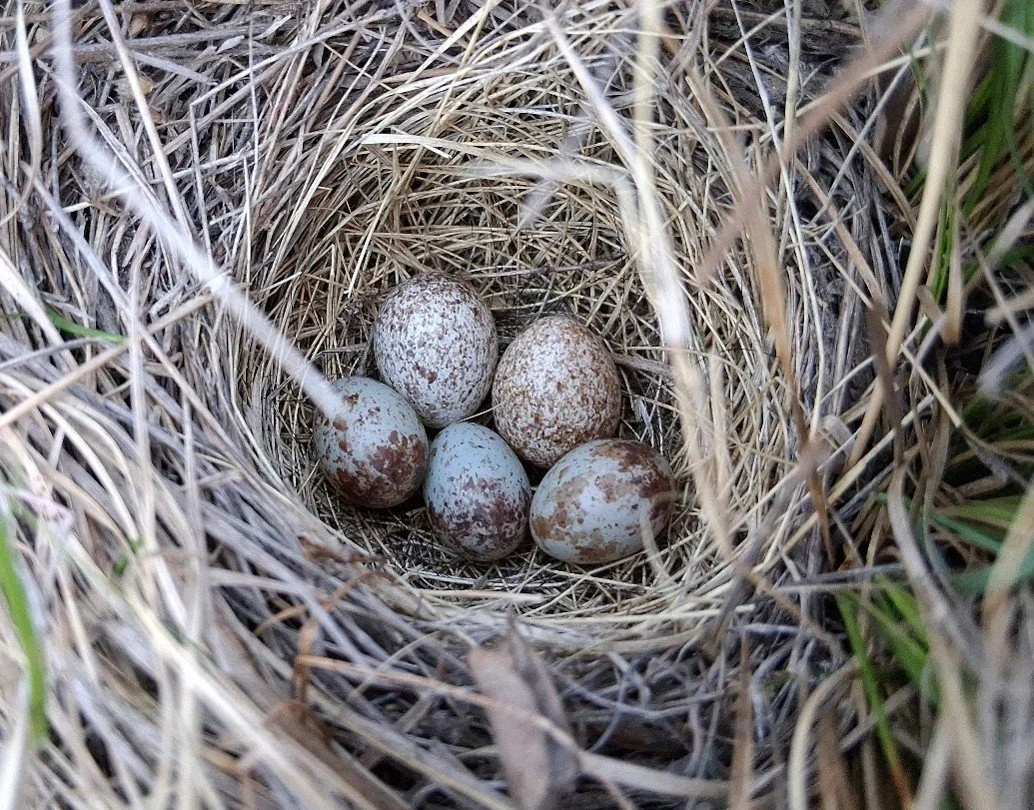
Two cowbird eggs (top), laid in a host nest.
Finally she glimpses the first egg, small and speckled in a bowl-shaped nest under the fragrant shade of a sagebrush. The sparrows chase her away, but she will be back.
In the hour before dawn, when the sparrows are roosting off the nest, she returns to the nest she didn't make and pushes the egg right out. In its place she lays another, a little larger than the original but similarly speckled – similar enough. The sparrows are none the wiser.
Then she will leave, following the bison herd which has grazed its fill here, picking at the insects stirred up by their hooves to replenish her energy reserves and grow more eggs. The bison are always on the move, and she can't afford to become sedentary and build a nest if she's going to keep up with them. So she will find another sparrow, or a lark or a warbler or a blackbird, and deposit her eggs in many nests, typically ten to twenty eggs in a breeding season.
Some of the unwitting foster parents will recognize the trick and expel the intruder's egg or abandon their nest to start over. But many won't, and this bird's chicks will all be raised by parents of another species, outgrowing their hosts, often taking more than their share of the food, leaving the host's own nestlings to starve.
After they fledge, her chicks might meet their siblings as they form flocks before migrating south for the winter. They will learn to whistle the same song so they'll be able to find mates next spring, when they return to the prairies to follow the bison in their millions.
In a few decades, though, the bison will be all but gone, hunted by a new wave of humans who leave most of the corpses behind to rot.
Often when one species disappears, the species that depend on them dwindle too. But a stroke of luck not only preserves these bison-birds, but transforms them into one of the most widespread and most disliked of North American birds. Because as the bison go, settlers follow with herds of cattle, and cut forests to create more pastures, and the bison-bird becomes the cowbird.
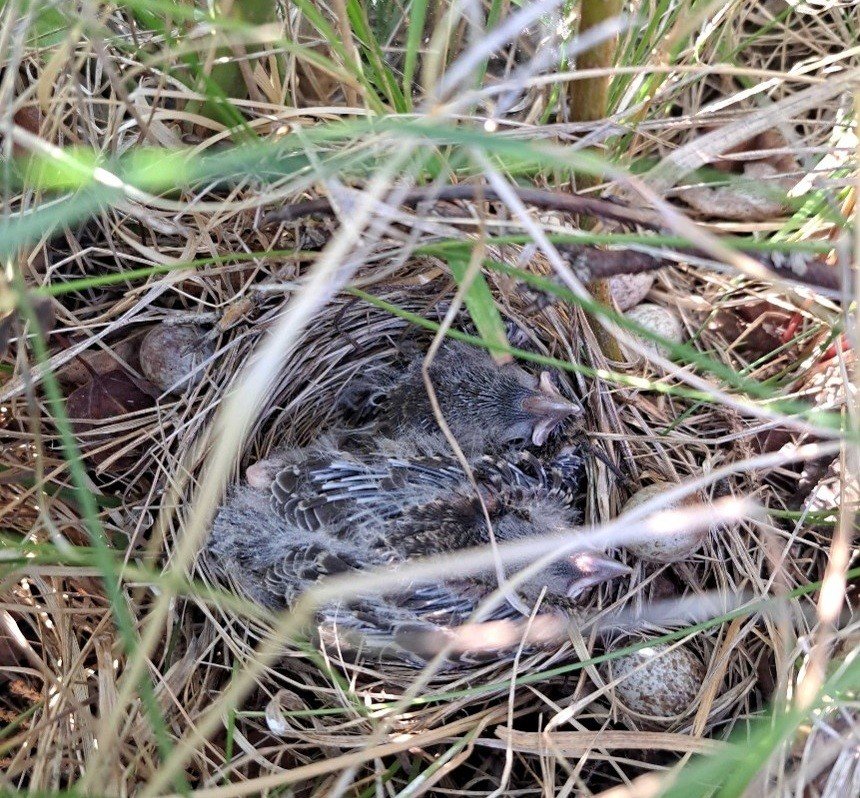
Cowbird nestlings.
Biologists and birders lament finding brown-headed cowbird (Molothrus ater) eggs in a nest. There's frustration that the nest makers can't recognize the parasite's obviously different egg, sympathy for tiny birds feeding nestlings that are much bigger than them. Less often is there recognition that the cowbird is behaving exactly the way it evolved to, that brood parasitism is an adaptation allowing cowbirds to follow their mobile food source, the bison. Nor is there recognition that the replacement of bison with cattle – which, even with pasture rotation, are comparatively stationary – along with the removal of intact forests helped the expansion of cowbird populations and increased the pressure they place on host species. Humans gave them an unasked-for opportunity and they seized it with the aplomb of the pigeon and the house sparrow – and got a similarly unflattering reputation.
Each spring and summer, environmental professionals conduct sweeps for native bird nests on sites of planned development and recommend mitigations to protect them. Sometimes those nests contain cowbird eggs or nestlings. We don't interfere with these nests – that would entail disturbance to the host species, which is (usually) protected under federal and provincial law. We understandably feel some sadness for the host parents, who might struggle to raise a parasitic chick at the expense of their own. But I suggest that we should also reserve some admiration for the cowbird, an adaptable, opportunistic species whose success lies, in part, at our own feet.
References and Further Reading
Alberta Wildlife Act. 2022. RSA 2000, c W-10. Alberta. Accessed June 3, 2024. https://kings-printer.alberta.ca/570.cfm?frm_isbn=9780779844401&search_by=link
Clotfelter, Ethan D. 1998. "What cues do brown-headed cowbirds use to locate red-winged blackbird host nests?" Animal Behaviour, 55(5):1181-1189.
Cornell University. 2026. "Brown-headed Cowbird." Accessed July 21, 2026. https://www.allaboutbirds.org/guide/Brown-headed_Cowbird
Luo, Ruiping. 2024. "The Missing Megafauna: A Story of the American Bison." Accessed July 21, 2026. https://www.albertawilderness.ca/the-missing-megafauna-a-story-of-the-american-bison/
Mayfield, Harold. 1965. "The brown-headed cowbird, with old and new hosts." Living Bird 4: 13-28. http://www.biodiversitylibrary.org/page/59398610
Migratory Birds Convention Act. 1994. S.C. 1994, c.22. Canada. Accessed June 3, 2024. https://laws.justice.gc.ca/eng/acts/M-7.01/
Neudorf, Diane L., and Spencer G. Sealy. 1994. "Sunrise Nest Attentiveness in Cowbird Hosts." The Condor 96: 162-169.
Ortega, Catherine P. 1998. Cowbirds and Other Brood Parasites. University of Arizona Press.
Payne, Robert B. 1965. "Clutch size and numbers of eggs laid by Brown-headed Cowbirds." The Condor 67, no. 1: 44-60.
Peer, Brian D., and Erik K. Bollinger. 2000. "Why do female brown-headed cowbirds remove host eggs? A test of the incubation efficiency hypothesis." In Ecology and Management of Cowbirds and Their Hosts, edited by James N. M. Smith, Terry L. Cook, Stephen I. Rothstein, Scott K. Robinson, and Spencer G. Sealy. University of Texas Press.
Peer, Brian D., Scott K. Robinson, and James R. Herkert. 2000. "Egg rejection by cowbird hosts in grasslands." The Auk 117(4): 892-901.
Rivers, James W., and Stephen I. Rothstein. 2023. "The Brown-headed Cowbird: North America's avian brood parasite." Avian Research 4, no. 1: 93-98.
Shaffer, Jill A., Christopher M. Goldade, Meghan F. Dinkins, Douglas H. Johnson, Lawrence D. Igl, and Betty R. Euliss. 2003. "Brown-headed Cowbirds in grasslands: their habitats, hosts, and response to management." USGS Northern Prairie Wildlife Research Center: 158.
Strausberger, Bill M., and Dirk E. Burhans. 2001 "Nest desertion by field sparrows and its possible influence on the evolution of cowbird behavior." The Auk 118, no. 3: 770-776.
Waiser, Bill. 2021. "Whither the bison: What happened to the Prairies' once-mighty herds?" Accessed July 21, 2026. https://www.cbc.ca/news/canada/saskatchewan/waiser-history-whither-the-bison-1.6154180
Written By: Laura Southcott, MSc., PhD., PBiol., RPBio. - AJM Intermediate Biologist