Canadian Offset Registry: Making Habitat Offsetting Easier to Find, Understand, and Deliver
When you're working on a project that requires a habitat offset, finding information about potential offset opportunities in Canada can be surprisingly difficult.
Where have offset projects already been completed? Are habitat banks available nearby? Who owns them? What species or habitats do they address?
Until now, there hasn't been a simple way to answer those questions.
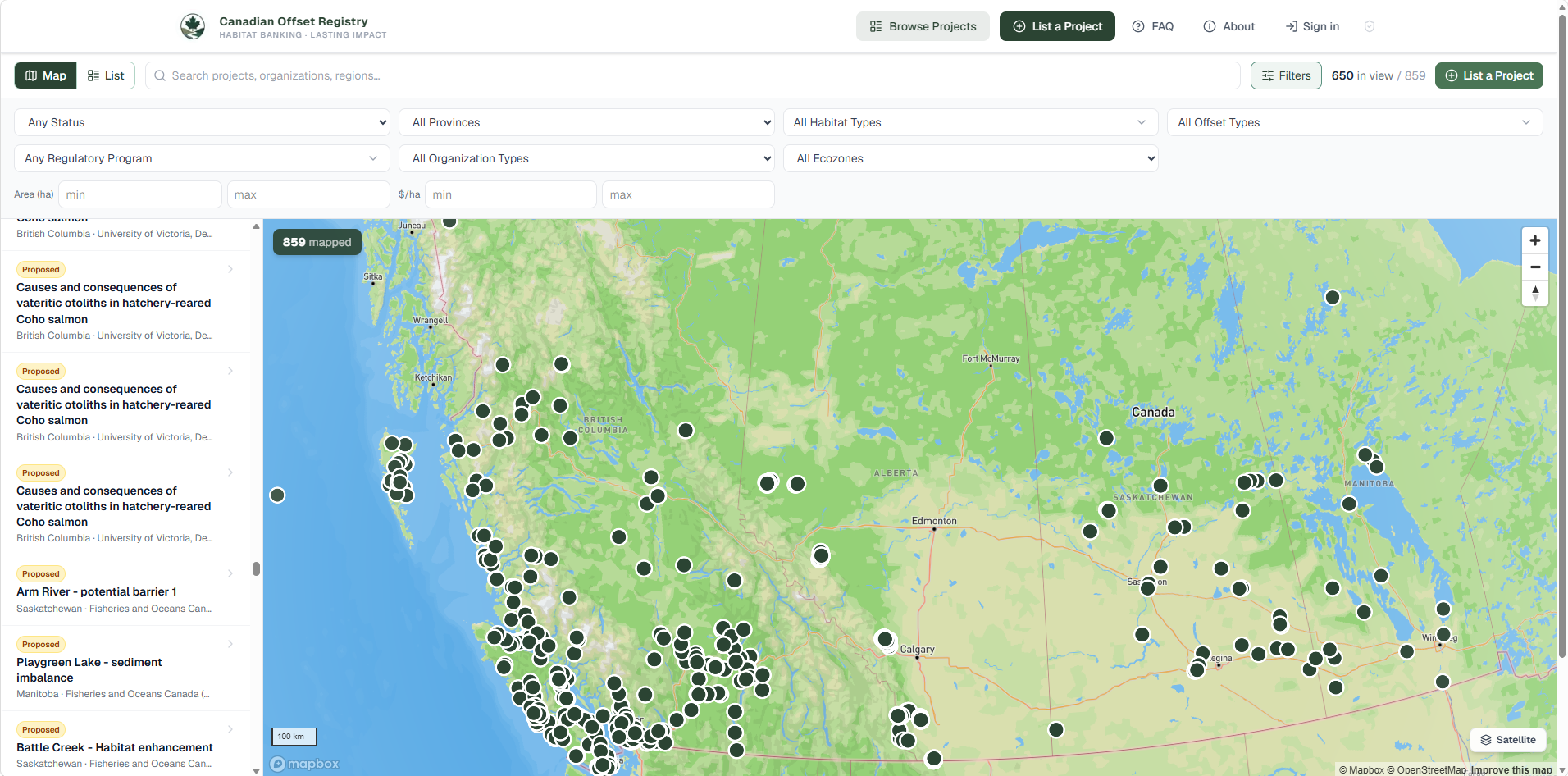
That's why AJM Environmental created the Canadian Offset Registry (COR), a free, public, map-based directory designed to make Canada's growing habitat offset market more visible, transparent, and accessible.
Our goal wasn't to create another regulatory process or platform that brokers transactions. It was to solve a simple problem we kept running into ourselves: finding information that should already be easy to find.
But first, let’s talk about what is habitat offsetting.
Before talking about the Registry, it helps to understand what habitat offsetting actually is.
Habitat offsetting is the process of compensating for unavoidable impacts to habitat (wetland, stream, forest, grassland, peatland, or species habitat) after developers have first avoided, minimized, and mitigated those impacts wherever reasonably possible.
In Canada, habitat offsets may be required under federal, provincial, territorial, or municipal regulatory frameworks, depending on the project and jurisdiction.
An offset might involve:
Restoring degraded habitat
Creating new habitat
Enhancing existing habitat
Permanently protecting important ecological areas
The objective is to ensure that unavoidable impacts are balanced by measurable conservation gains elsewhere.
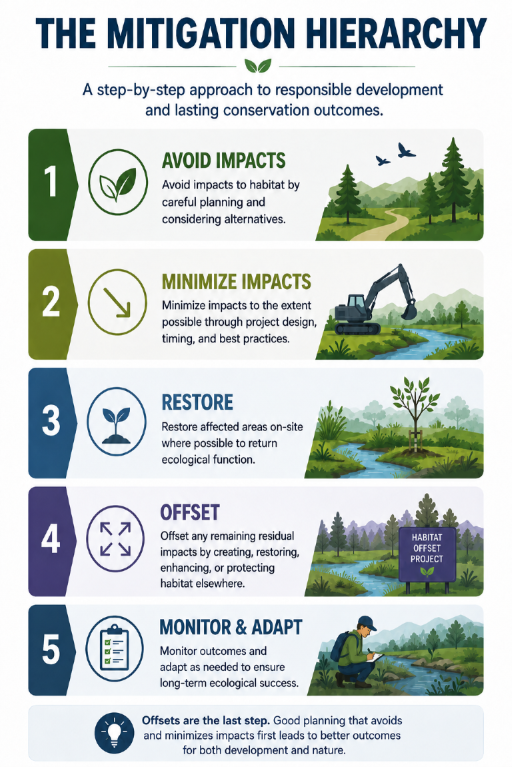
Offsets are generally considered the final step in the mitigation hierarchy:
Avoid impacts
Minimize impacts
Restore affected areas where possible
Offset any remaining residual impacts
In other words, habitat offsetting is not a substitute for good project planning or a blank cheque to cause avoidable environmental effects. It is intended to address the impacts that cannot reasonably be avoided after every practical mitigation measure has been applied.
What can a habitat offset look like in practice?
We don't have to look far for an example.
Following Calgary's 2013 flood, the City of Calgary undertook a number of projects to repair and reinforce riverbanks along the Bow and Elbow Rivers. The work was necessary to protect critical infrastructure, but some of it also negatively affected sensitive fish habitat.
To compensate for that habitat loss, the City developed a Fish Habitat Compensation Plan and identified locations where fish habitat could be restored or created. One of those locations was Quarry Park along the Bow River.
At Quarry Park, the City excavated and reconnected an approximately one-kilometre historical side channel to the Bow River. The project also added fish habitat features using large trees and boulders and replanted the channel banks and other disturbed areas with native trees, shrubs, and grasses. The project was completed in 2017.
It's a tangible example of habitat offsetting in practice: where impacts to fish habitat occurred as a result of necessary infrastructure work, habitat was created and restored elsewhere to help compensate for that loss.
What is habitat banking?
Habitat banking builds on the same concept but takes a more proactive approach.
Rather than waiting until a development project requires an offset, a habitat bank restores, enhances, creates, or protects habitat in advance. The ecological gains generated by that work can then be quantified as credits and, where permitted by the applicable regulatory framework, used to help offset impacts from future development projects.
A credit represents a defined amount of ecological gain. Depending on the type of bank and regulatory program, credits might be based on factors such as the area of wetland restored, the length or function of stream habitat improved, or gains to habitat for a particular species.
The number and type of credits generated by a bank are determined through ecological assessment and the requirements of the applicable regulatory program. When a future project causes an authorized residual impact, or debit, eligible credits from the bank may be used to help satisfy the project's offsetting requirements.
Think of it this way:
Traditional habitat offsetting is often undertaken one project at a time. When a development requires an offset, the proponent may need to identify, design, construct, and monitor an offset specifically for that project.
Habitat banking changes the timing. Habitat improvements are completed in advance, creating a supply of recognized ecological gains that may be available when future offset requirements arise.
This approach can also create opportunities for larger, more strategically planned conservation projects that may serve multiple future developments.
In many parts of the world, habitat banking has become an important conservation tool because it can:
Deliver larger, more connected conservation areas
Restore habitat before development impacts occur
Reduce duplication of effort
Support long-term management and monitoring
Provide greater regulatory and cost certainty for project proponents
In the United Kingdom, for example, Biodiversity Net Gain became a mandatory planning requirement in England in 2024, requiring developments to deliver a biodiversity value at least 10 percent greater than what was there before, with habitat banks supplying off-site biodiversity units.
Habitat banks can be developed by conservation organizations, Indigenous Nations and communities, private landowners, restoration companies, governments, and project proponents. Internationally, different models have emerged, ranging from banks developed and managed by specialized restoration companies to conservation organizations and landowners generating ecological credits from restoration or protection projects.
Canada's habitat banking market is still emerging. To date, habitat banking has largely operated through proponent-led models, where proponents establish habitat in advance to address potential offset requirements associated with their own future projects. Canada's federal Fisheries Act provides for fish habitat banking, and Fisheries and Oceans Canada released updated guidance in 2026 for establishing and managing fish habitat banks.
A broader market in which independent third parties can establish habitat banks and make credits available to other proponents could create additional opportunities for conservation investment in Canada as regulatory frameworks continue to evolve.
At its core, habitat banking changes the timing of conservation. Instead of waiting for an impact to occur before an offset is developed, habitat can be restored, enhanced, or protected in advance.
And that creates an interesting opportunity: if there is greater visibility into both the supply of habitat projects and the potential demand for offsets, could that visibility help attract more investment into restoration in the first place? We hope so.
The problem we kept encountering
As environmental consultants, we spend a lot of time helping clients navigate environmental approvals.
Again and again, we found ourselves asking the same questions:
Has anyone already completed an offset nearby?
Is there an existing habitat bank that could meet project needs?
Who owns that project?
Is the information public?
Where do you even start looking?
The answers were scattered across regulatory documents, environmental assessments, public registries, government websites, consultant reports, and sometimes nowhere publicly available at all.
There was no single place to understand what offset projects existed across Canada.
That lack of visibility makes life harder for everyone. Developers spend more time searching for opportunities. Landowners and conservation organizations have fewer ways to showcase restoration projects. Regulators receive repeated requests for information that may already exist. Consultants duplicate research that someone else has already done. Most importantly, the market develops more slowly because participants simply cannot see one another.
Why market visibility matters
Healthy markets depend on information. When participants can easily see what's available, better decisions tend to follow. That's true whether you're buying a house, hiring a contractor, or planning a vacation. Habitat offsetting is no different.
Greater transparency helps project proponents understand their options earlier in project planning. It allows restoration organizations, Indigenous communities, conservation groups, landowners, and habitat bank operators to showcase projects that might otherwise remain largely unknown. It helps regulators and practitioners better understand where conservation work is already occurring.
Over time, increased visibility may also encourage investment in larger, strategically planned restoration projects by making future demand easier to understand.
Transparency doesn't solve every challenge, but it removes one unnecessary barrier.
Why AJM built the Canadian Offset Registry
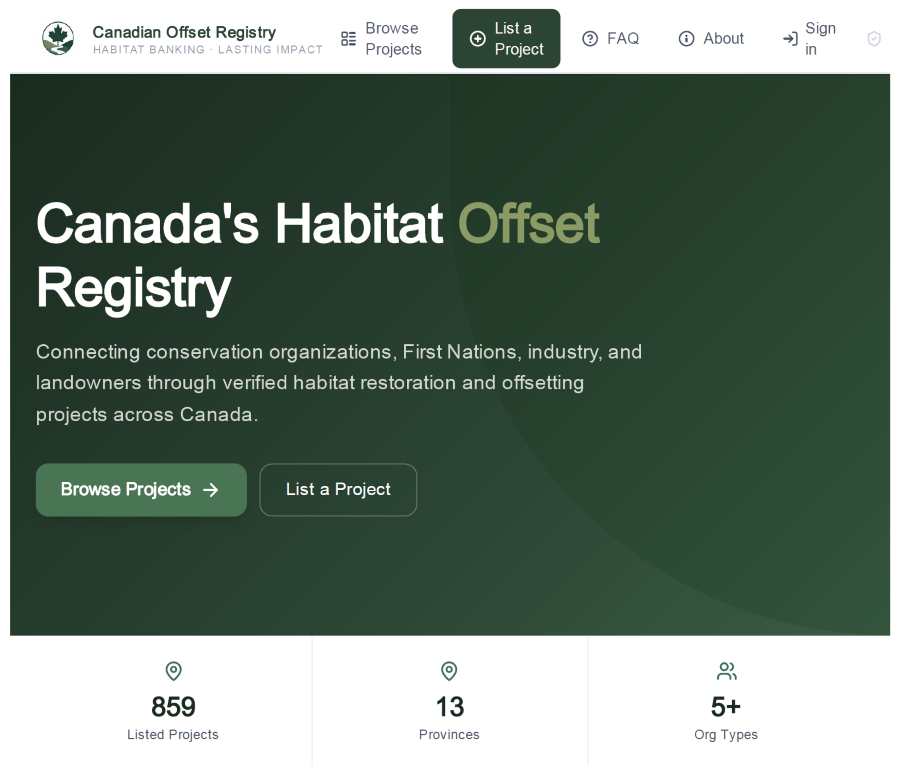
The Canadian Offset Registry was built to make the market easier to navigate.
It is a free, public directory that brings together habitat offset opportunities from across Canada into one searchable map.
Project holders can submit listings.
Users can search by location and project details.
Interested proponents can contact project holders directly.
AJM does not broker transactions, certify projects, or assign ecological value. The Registry simply helps people discover projects that already exist and connect with those responsible for them.
Our role is to improve visibility, not regulate the market.
We understand that not every project can be public. Sensitive land transactions, early-stage negotiations, and species-at-risk locations often can't appear on a public database. The Registry supports confidential listings that stay off the public directory and are shared only with parties COR has verified.
Who benefits?
The Registry was designed for anyone involved in habitat offsetting, including:
Project proponents looking for potential offset opportunities
Environmental consultants supporting project approvals
Indigenous communities leading restoration initiatives
Conservation organizations
Landowners interested in habitat banking
Government agencies and regulators
Researchers and students studying Canada's evolving offset market
Even members of the public interested in ecological restoration can explore projects occurring across the country.
Looking ahead
Habitat offsetting in Canada continues to evolve. New policies, new restoration projects, and emerging habitat banks will all shape how responsible development occurs over the coming years. For that evolution to happen efficiently, people first need to know what already exists. That's the purpose of the Canadian Offset Registry.
By making Canada's habitat offset market easier to see, we hope to support better collaboration, better planning, and ultimately better conservation outcomes alongside responsible development.
After all, you can't connect opportunities that no one can find!
About the Canadian Offset Registry
The Canadian Offset Registry is a free, public, map-based directory of habitat offset projects and habitat banks across Canada. The Registry helps connect project proponents, consultants, regulators, Indigenous communities, conservation organizations, and landowners by making offset opportunities easier to discover and explore. Browse the database or submit a project at www.canadianoffsetregistry.ca.